Posts

Shale Industry Is Prioritizing Debt Over New Well Drilling

Image
             Despite the increase in U.S. oil demand, big shale producers are focusing on their debt over drilling. They are keeping true to what they've told their investors by cutting costs throughout the whole industry. Contrary to publicly owned shale companies,  privately-owned  shale producers are now focusing on increasing their productivity, as we mentioned in a previous post.       This is good news for OPEC+, as this will restrain output and drive crude prices higher without unleashing a barrage of supply from U.S. rivals. The U.S. shale industry is slowly coming back, but this new approach will leave oil output below pre-pandemic levels until late next year. Michael Tran, managing director for RBC Capital Markets, stated that publicly traded explorers that remain restrained on output are aiding to keep crude prices up.  Michael Tran also said, "the more restrained shale drillers are this year, the more...

The Negative Impact of the Pandemic and Arctic Weather Affect Oilfield Workforce

Image
            Without a doubt, the shale industry has boosted job creations throughout the US. When the industry began to boom back in 2012, it created  1.8 million jobs . At the start of the fracking boom, workers were paid an average of $35.15 per hour, which was higher than the general economy's wages.      Experts even estimated that the shale industry would bring in $111 billion in federal and state government revenues in 2020. Unfortunately, due to the COVID-19 outbreak in 2020 and the  extreme cold weather  that affected major shale sites only a few weeks ago, the industry has taken a toll. Despite the oil and gas market steadily getting back on its feet, the negative effects are still being seen. Shale Workforce Cut      Major fracking companies and the companies that manufacture the equipment have had to cut down on personnel over the past months. An estimated 12,321 jobs cut over the past three month...

How Privately Owned Shale Drillers are a Threat to OPEC

Image
  As already discussed in  previous posts , the U.S. shale industry is finally gaining its strength back after months of decline. To much surprise, this resurgence is largely due to privately owned shale drillers and not the other giant corporations. This has worried OPEC as it will affect their overall market shares in the oil business.  How are these privately owned corporations usurping the U.S. oil market share from OPEC? That is what we will discuss today, but first, let's look at what OPEC is.  OPEC - Organization of the Petroleum Exporting Countries The OPEC was established on 14 September 1960 and has continued to play a significant role in influencing the global oil prices. Currently, 13 countries are members of the OPEC, all of which have substantial oil reserves. Their  mission statement  is: " to coordinate and unify the petroleum policies of its member countries and ensure the stabilization of oil markets, to secure an efficient, economical and...

Why the Utica Shale is Under-Appreciated

Image
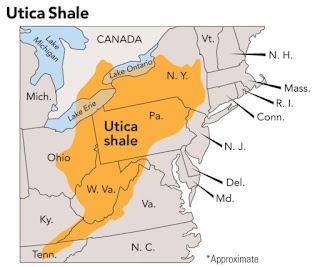
In the United States, there are seven main Shales (Bakken, Niobrara, Permian, Eagle Ford, Haynesville, Marcellus, and Utica). The Permian and Eagle Ford Shale, located in Texas, are the highest producing Shales in the United States. Among all of them, the Utica Shale seems to be the one with less popularity despite bringing many investments and job opportunities for Ohio. In today's post, we will discuss why the Utica Shale is under-appreciated and how it has benefited Ohio. Marcellus Shale Perhaps one reason why the Utica Shale is under-appreciated is that it's located right next to the Marcellus Shale. The latest report estimates that the Marcellus Shale yields about 14.4 billion cubic feet of natural gas per day. In 2015, it was the source for over 36% of the shale gas produced in the United States and 18% of the total dry gas production of the United States. Of course, the Utica Shale is small in comparison to the Marcellus Shale. Despite that, the Utica Shale still holds s...

What Is Fracking Doing To Your Health?

Image
  Without a doubt, you've come across hundreds of articles both in favor and against fracking. If you've been a long-time reader of The Daily Digger, you've also been able to see many different news articles related to the pros and cons of fracking. While some (both in favor and against) base their reasons on scientific facts, others may take the liberty to add their facts that aren't scientifically proven.  Today we will try to explain if fracking can harm your health. We won't take a side in this matter; instead, state the scientific facts. All the information used in this article is taken from the  NIEHS  (National Institute of Environmental Health Sciences).  The Process of Hydraulic Fracturing We won't get into too much detail, as a lot is involved, but basically, it's a process used to extract natural gas and oil from deep rock deposits known as shale. Water, sand, and a mix of chemicals are forced into horizontally drilled wells, causing the shale to ...